
living and community
Pledge
Join our patrons and commit to standing against racism and displaying the campaign’s digital badge and social media resources.
Page

Join our patrons and commit to standing against racism and displaying the campaign’s digital badge and social media resources.
Use this directory to find out how some of the names of parks, places or community infrastructure came about.
Note: the inclusion of a park name in this directory does not imply official endorsement of the name by Sunshine Coast Council or any other authority.

Tickets for the 2025 U19 Men’s and Women’s State of Origin fixtures are now on sale.
For over four years now, we’ve been looking back at our early heritage through the Backward Glance stories. The Nambour Chronicle in the 1920s was following a similar practice with its column called “20 years ago”.

Origin fever is set to sweep the Sunshine Coast as the mighty Maroons lock in the region as their high‑performance training hub for 2026.
Woombye’s main street is getting a facelift to mark the town’s momentous 135th birthday. From depot to township, Woombye’s golden history has remained with its country charm and enticing character becoming more prominent in the recent draft streetscape designs for Blackall Street.
This bridge has been named in honour of a local pioneer farmer. Charles Valentine Downes who used locally cut bush timbers to construct the original bridge over this site. The project commenced in 1939 and was completed in 1940. The original bridge remained in service to the community until 1996.
Original handmade mosaic using Old English china for the more delicate vintage appeal.
The Maleny Music Weekend was originally created as a celebration of 25 years from the first Maleny Folk Festival
Last week we focussed on the origin of the name Mons which is named after the Battle of Mons and this week we shine the spotlight on the Mons School.
This reserve was originally controlled by Yandina Race Club until approximately 1949, who held annual race days there since 1888. Date named: 1 January 1986
We help Council maintain the Tramway Walking Trail and raise funds for a building for the display the original locomotive in central Buderim.
The group is concerned with preserving the history of the Palmwoods to Buderim Tramway, 1914-1935.
Renaming of the Parks Glen Retreat Park and Orungal Park to reflect the heritage of the area being the name of the farm and the mandarins that were grown there by the original owner Albert Short in 1909 and the freight and passenger Ship Orungal that used to sail up and down the Queensland Coast from Cairns to Melbourne from 1927.

A new surf observation tower at Marcoola Beach has been craned into place, marking a significant enhancement to beach safety for the Marcoola community.
Named after Friedrich (Fred) and Harry Vandreike who were pioneers of Witta having obtained original selections of land granted by the Government at Teutoburg (now Witta) in 1887. The Vandreike families donated land to the community for the school, church, sportsground and cemetery. The first school was built of pit-sawn timber by Mr. Fred Vandreike and Mr. Ludwig Bergann which opened on 3rd October 1892.
Originally called the Botanical Gardens, the five hectare site was brought to the attention of the Landsborough Shire Council by then Councillor Ben Bennett, who realised the need to preserve such a refuge in a fast developing neighbourhood. The name of the Botanical Gardens was later changed to Ben Bennett Park, in Councillor Bennett’s honour. Ben served on the Landsborough Shire Council from 1964 to 1967.
Council suggested the name Crummunda Park because this particular area had been named ‘Crummunda’ by surveyor Burnett in his original plan of survey in 1845. Early surveyors of the Moreton Bay district took time to ask local aborigines the names of local features, which the surveyors then noted on their plans. Unfortunately, the surveyors seldom noted the English meanings of the place names given and with the passing of the aborigines many of these meanings will never be known. At the time that the place name Currimundi, also spelt Curramundi, is a corruption of the Kabi dialect words meaning “place of flying foxes”.
The original owner of the land was Robert Earnest Horton. Robert moved to Maroochydore in the early 1920's. He was a very generous man always helping out where he could in charity related things for the community. One of those gestures was donating his land, today known as Horton Park, for the use of the Maroochydore community. Always a community-minded man, Robert donated the land in 1929 for the use of golf and other recreation. After his death in 1934, his donation went on to fulfil the lives of many keen golfers in the Maroochydore region. The Horton Golf Club was established in 1950. A shed and an outhouse was erected in 1952. Today, the Horton Golf Club members have moved to the Maroochy River Golf Club in Bli Bli. Robert's generosity and community involvement is remembered with Horton Park and the street running parallel to the Sunshine Plaza, Horton Parade, named in his honour.
Many of the trees in Caplick Park in Eumundi were planted by Eumundi pioneer Dick Caplick, rather a quirk seeing as he spent most of his early life cutting down trees. Like others of his time, tree-cutting was the job of the moment. It was in later life he wanted to replace that which he had removed in his youth as a Eumundi tree-cutter. Born in 1893 at Canungra, Dick Caplick came to Eumundi in 1901 and attended the local school. His four brothers, Fred, William, August and Ronald were all considered expert scrub fellers and timber workers and their services were constantly sought. Dick lived until he was 94, he had a love for plants and trees and felt as though he was giving back when he planted in Caplick Park. Dick Caplick was part of Eumundi pioneer family, timber getter, adventurer, outdoorsman and war veteran. Dick was born in 1893 and died in Nambour 1987. His statue was originally in this park.
Ambulance Wish Queensland is the signature program of Palliative Care Queensland. Originally founded in the Netherlands, Ambulance Wish Queensland was inspired by the famous Hervey Bay paramedics who took a dying woman to the beach for her last wish.
It is now a global movement that first came to Australia through Palliative Care Queensland in 2019.
With the support of Queensland Health and Queensland Ambulance Service, Ambulance Wish Queensland fulfilled our first wish for Betty who wanted to enjoy a passionfruit ice-cream in Brisbane’s Botanic Gardens.
Since 2019, our program has grown, and building on our success in South-East Queensland, we now have four AWQ hubs across Queensland, in Brisbane, Townsville, The Sunshine Coast and Toowoomba.
The purpose of the program is simple: to give Queenslanders living with a life-limiting illness access to coordination, planning, specialist transport and clinical care required to fulfil their last wish and create memories forever. Wishes would not be possible without our team of volunteers who, with our fleet of Ambulance's: ‘Ross’, ‘Betty’, ‘Usha’ & ‘Liz’, are able to provide the specialist care and transport for our Wish Recipients.
William Landsborough was Australia's most successful explorer, exploring large areas of Queensland. In 1864, he was appointed to Queensland's Upper House, the Legislative Council. He served three to five months. In 1881, in recognition of his efforts, the Queensland Government grant him $2000. In 1882, using some of his grant, he bought 2372 acres (now know as Golden Beach). He grazed his horses and bred merino sheep. Even though he had help from the Maltman, Leach and Cramb families, his enterprise failed. He built a home and named it 'Loch Lamerough' after a place he remembered fondly from his birth country, Scotland. On 16 March, 1886 William Landsborough died and was buried near Pumicestone Passage near his home Loch Lamerough what is now an area of Golden Beach. Early settler Sam Leach of Caloundra read the funeral service. William Landsborough’s remains were exhumed at request in 1913 for internment at Toowong Cemetery. A memorial monument was built by public subscription at Toowong Cemetery. He is buried near his second wife. A stone cairn was built at Golden Beach after Queensland Main Roads located the original site of his burial as they were building a gravel road during WW11 for the Australian Army. This gravel road was built to access what became known as Military Jetty at Golden Beach adjacent to the Bribie Island Military Fortifications built on the northern end of Bribie during WW11 and known as Bribie Battery. Date named: 1 January 1939
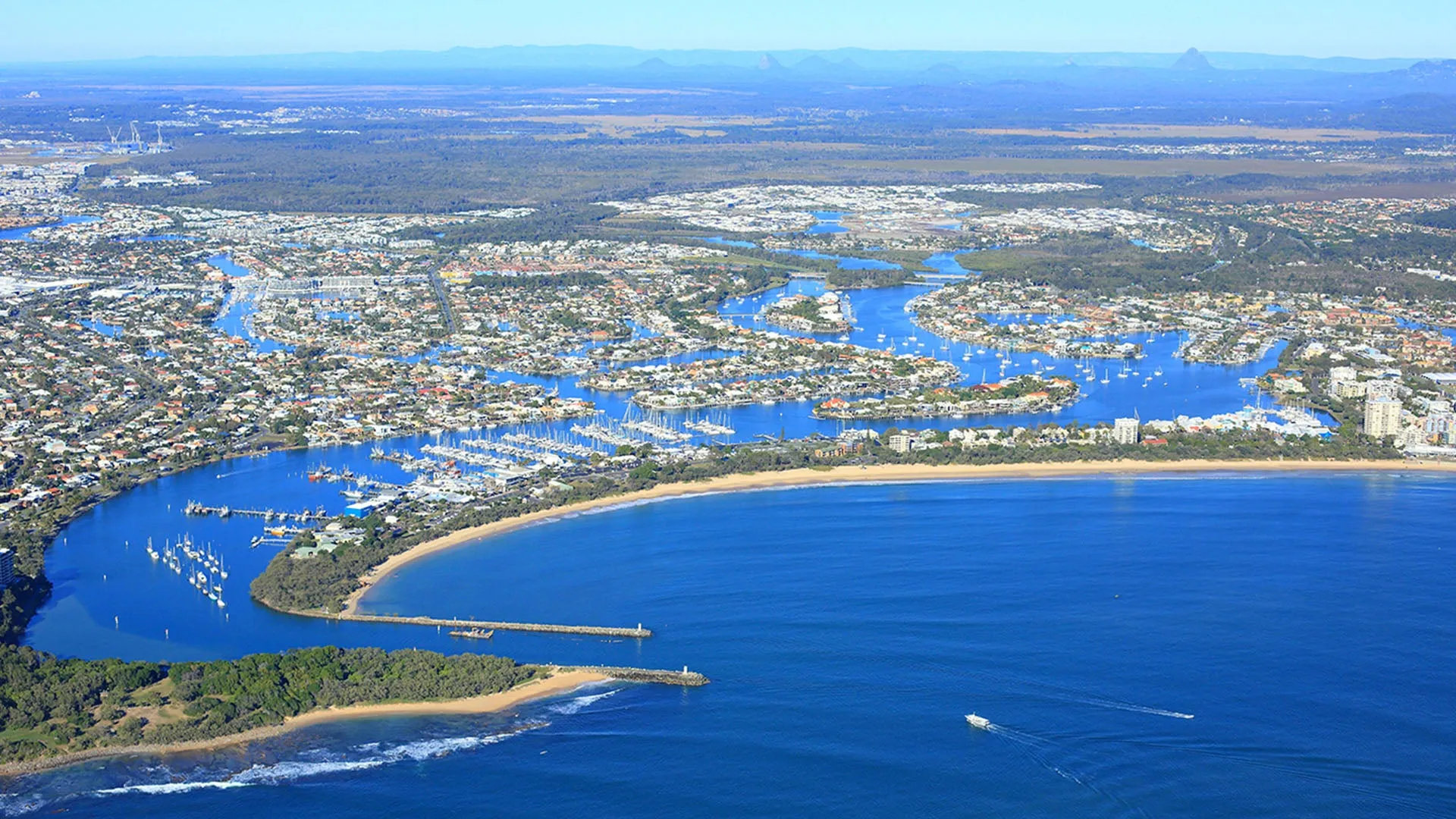
A canal maintenance plan will be developed to outline works planned on the six major canal systems and a range of public access points across the Sunshine Coast following a review of council's current practice.
This year marks the 150th anniversary of the founding of Bankfoot House at Glass House Mountains by pioneers William and Mary Grigor.